
Not all SSL is the same
Free SSL certificate
Paid SSL certificates offer additional services depending on the type. These include, for example, organizational validation, wildcard certificates for subdomains, or certificates from established certificate authorities for commercial purposes.
Simple DV certificate
Starting from
Starting from
Starting from
Starting from
SSL & HTTPS
Encrypt the data transmission between the browser and web server and provide your website securely via HTTPS.
The certificates we offer support strong 256-bit encryption, which ensures secure data transmission.
In addition to the domain, OV and EV SSL certificates also verify the identity of the company or organization.
With a wildcard certificate, protect not only your main domain but also the associated subdomains, for example mail or webmail, as well as other services.
Depending on the product, the commercial SSL certificates offered include a trust site seal as an additional proof of trust.
DV certificates can be issued within a short time after successful domain validation. For OV and EV certificates, a longer processing time is required due to the identity verification.
Free re-issuances are provided for the offered certificates, for example, if a certificate needs to be re-issued during its validity period.
Choose SSL certificates from established certification authorities and brands, for example RapidSSL, GeoTrust, or DigiCert.
Select SSL certificate
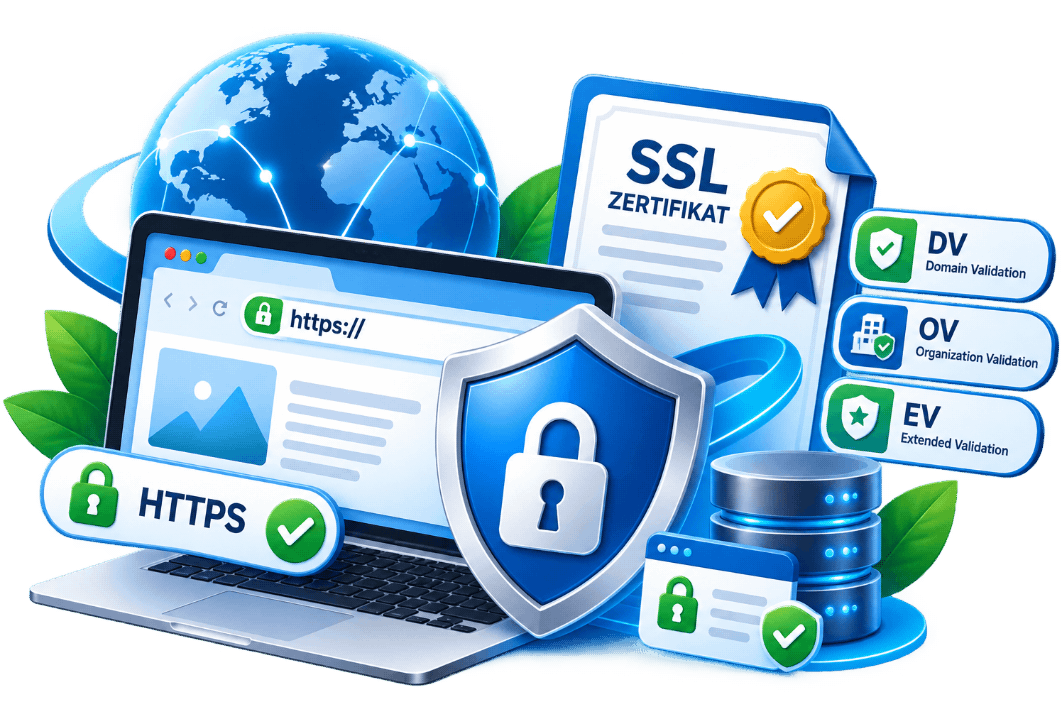
DV (Domain Validation): For websites, blogs, and smaller projects. This verifies that you own the domain. Issuance is usually very fast.
OV (Organization Validation): For companies and organizations that additionally want to have their identity verified. In addition to the domain, the organization is also validated by the certification authority.
EV (Extended Validation): For companies with increased identity verification requirements. EV uses a particularly extensive validation process before issuing the certificate.
A SSL certificate enables an encrypted connection between the web server and your visitors' browser. This allows your website to be accessed via HTTPS and protects the data transmitted during the connection.
SSL or HTTPS is now a technical standard for websites—especially for contact forms, logins, customer accounts, or online stores. Your previous SSL page also describes the encrypted connection between browser and server as a core function of an SSL certificate.
Yes, for a great many websites. A free Domain-Validated certificate also enables an encrypted HTTPS connection and is suitable for many corporate websites, blogs, Club pages and WordPress websites completely sufficient.
With CURIAWEB Webhosting, free SSL is already included. A paid certificate becomes interesting if you, for example, a Organization Validation (OV or EV), you need a specific commercial certificate or another special certificate solution.
The essential difference lies in the scope of Validation prior to certificate issuance.
At DV (Domain Validation) only the control of the domain is checked. In the case of OV (Organization Validation) the organization or company is additionally validated. In EV (Extended Validation) an even more comprehensive verification of the company identity is carried out.
However, an EV certificate does not automatically mean stronger encryption than a DV or OV certificate. For example, the certificates you offer all feature 256-bit encryption, but differ in terms of validation and the issuance process.
A Wildcard SSL certificate protects a domain along with its subdomains on the same domain level.
This is practical, for example, if you want to secure services or areas like shop.example.ch, mail.example.ch, or portal.example.ch in addition to www.example.ch. Instead of using a separate certificate for each of these subdomains, a wildcard certificate can cover multiple subdomains.
For a normal WordPress website a free DV SSL certificate is sufficient in many cases. First of all, it is crucial that the website can be accessed correctly via HTTPS.
A commercial SSL certificate can be useful if the project meets additional requirements – for example, organizational validation or the securing of multiple subdomains via a wildcard certificate.
That is not strictly necessary. Even a free, properly configured DV certificate enables an encrypted HTTPS connection.
OV or EV certificates can be interesting for companies and e-commerce projects if the company's identity is also to be verified by the certification authority. Your product range accordingly includes OV and EV certificates for Business and e-commerce applications.
An SSL certificate alone does not automatically ensure a better positioning of a website in Google search results. HTTPS is now much more the technical standard for modern websites.
You should therefore use SSL primarily for a encrypted data transmission and a correctly provided website via HTTPS deploy and not buy an expensive SSL certificate in the hope of thereby achieving a relevant ranking jump.
That depends on the type of certificate. DV certificates can usually be issued within a few minutes after successful domain validation.
At OV and EV certificates the issuance takes longer because additional company data must be checked. For the currently offered products, GeoTrust True BusinessID, for example, 1–3 days and for the GeoTrust True Business ID with EV 1–5 days specified.