


A domain is one of the most important components of a digital presence. It provides access to websites, email addresses, and often other business services. Nevertheless, domain renewals easily become an afterthought in everyday life.
This can have unpleasant consequences: The website suddenly becomes unreachable, business emails stop working, and in the worst case, a domain can be registered by someone else after its final release.
But what actually happens when a domain expires? This guide explains the possible processes, why deadlines differ depending on the domain extension, and how you can prevent an important domain from being lost.
Why can a domain expire in the first place?
The right to use a domain is not automatically unlimited. Domains are registered and renewed in accordance with the terms of the respective registry and registrar.
If a required renewal is not carried out, the registration may expire.
Typical causes for this include:
- outdated email or contact data at the registrar
- an expired payment method
- missing or disabled automatic renewal
- unclear responsibilities within the company
- The domain is still managed by a former employee.
- a former agency is the only one that has the necessary access
Especially in companies, such situations frequently arise from historically grown structures: domains were registered at some point, but years later no one knows for sure who is responsible for managing them.
What happens when a domain expires?
There is no answer to this that is identical for all domains. The specific deadlines and procedures depend on the domain extension, the responsible registry, and sometimes also on the registrar.
A .ch domain may therefore be subject to a different procedure than, for example, a .com, .net, or .de domain.
For many domain extensions, there are various phases after the end of the regular registration period before a domain finally becomes freely registerable again. However, the exact name and duration of these phases can differ.
1. The registration period ends
First, the current registration period is ending. Depending on the domain extension and provider, a regular renewal may still be possible at this time.
This does not necessarily mean that the website and email will go down immediately at that exact moment. However, you should by no means rely on that.
2. Possible goodwill or extension phase
For certain domain extensions, a phase exists after expiration in which the previous domain holder can still renew or restore the domain.
The terms and deadlines vary depending on the TLD and registry.
3. Domain and connected services may fail
If the domain is not renewed in time, its technical resolution may be impaired or disabled.
Then the following problems, among others, may occur:
- The website is no longer accessible via the domain
- Emails to the domain can no longer be delivered
- Subdomains no longer work
- External services or logins that depend on the domain may be affected.
4. Recovery may still be possible
With some domain extensions, there is an additional redemption phase, often called Redemption Period referred to as.
During this phase, the domain can still be recovered under certain conditions. However, additional fees may apply.
Here too, such a phase does not exist in the same form for every domain extension.
5. The domain will be released again
Once the respective expiration and deletion process is fully completed, a domain can be released again for general registration.
From this point on, it may potentially be registered by third parties. In the case of an important corporate or brand domain, this can have significant consequences.
What risks arise from an expired domain?
With a business-used domain, it's not just about a website being inaccessible for a few hours or days.
The effects can reach significantly further.
Website outage
If the domain can no longer be properly accessed, customers may no longer be able to find the website. In the case of an online store or a business-critical website, this can directly result in financial damage.
Email outage
Particularly critical is the connection between domain and email. Business addresses like name@unternehmen.ch are directly dependent on the domain.
If the domain no longer functions correctly, incoming messages may be rejected and sending may be affected.
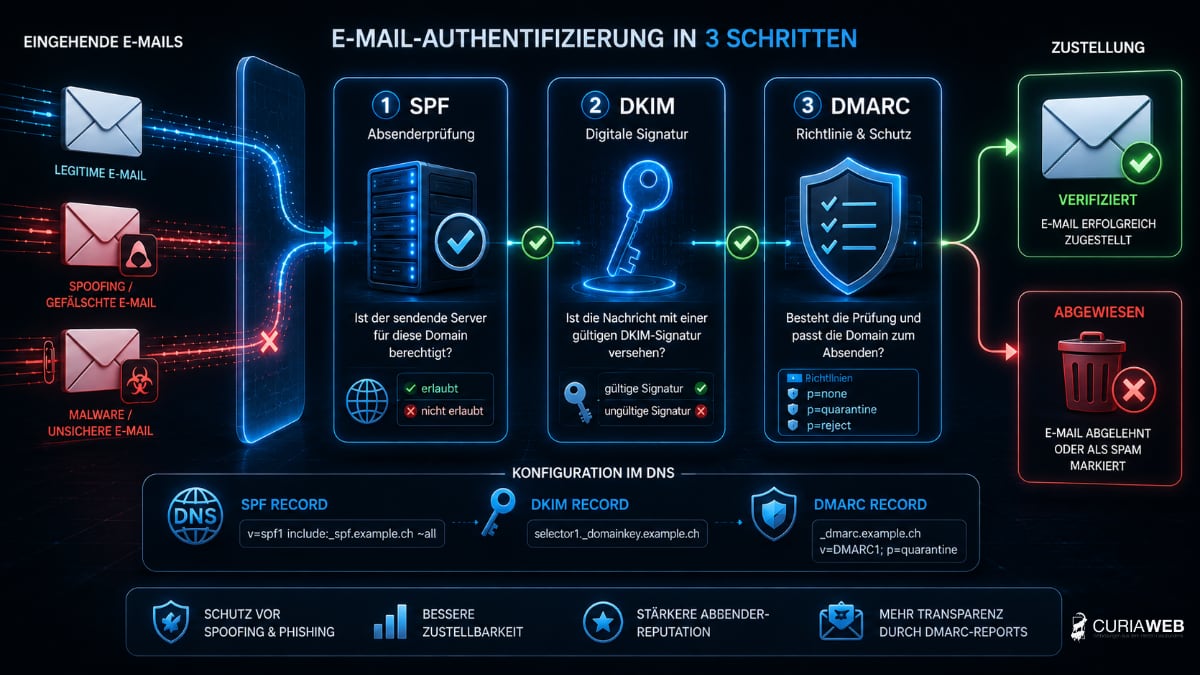
For more information on this topic, please see Email security and spam protection.
Loss of trust and reputation
An unreachable company website or bounced emails quickly appear unprofessional to customers and business partners.
What is particularly problematic is that outsiders usually cannot tell whether a domain renewal was simply forgotten or whether the company is fundamentally no longer reachable.
Impact on search engines
If a website is inaccessible for a longer period of time, it can also affect its visibility in search engines.
How strong the effects are depends, among other things, on the duration and type of the outage. A blanket statement like „the rankings are lost after that“ would therefore be incorrect.
Loss of the domain
The greatest risk arises when the complete expiration process is finished and a valuable domain can be registered freely again.
If it is subsequently registered by a third party, a simple renewal via the previous registrar is no longer possible.
Why a lost corporate domain can be particularly dangerous
A former corporate domain can be of interest to third parties because it may have been used for years and is still well-known.
Conceivable risks include, for example:
- Visitors are still accessing the old domain
- External websites still link to this domain
- old documents or promotional material contain the address
- Customers still know former email addresses
Therefore, business-relevant domains should not be abandoned rashly even if a website is no longer actively used.
How to protect yourself against expired domains
The good news: Most problems surrounding expired domains can be avoided with simple organizational measures.
Use automatic renewal
If your registrar offers automatic renewal, it usually makes sense for important domains.
However, it should be checked regularly whether stored payment information and account details are still up to date.
Keep contact information up to date
Information on renewal only helps if it reaches the right person.
Therefore, please avoid using an individual employee's email address that will no longer exist after their departure.
Define clear responsibilities
The company should clearly regulate who manages domains and who has access in the event of representation.
Access data should not reside exclusively with a single person or an external agency.
Manage domains centrally
When domains are distributed across numerous registrars and user accounts, the administrative effort increases.
A centralized administration creates an overview of domain inventory, responsibilities, and renewals.
Information on registration and management can be found in our section Domains.
What to do if your domain has already expired?
Then you should not wait unnecessarily. First, check with your current registrar to see what status the domain has and whether a renewal or restoration is still possible.
It is important not to make any premature changes to DNS, hosting, or email as long as the status of the domain is not clarified.
The earlier you react, the greater the chance usually is to recover the domain within the intended procedure.
Can an expired domain still be transferred?
That cannot be answered generally. Whether a transfer is possible depends on the status of the domain, the domain extension, and the respective transfer rules.
Therefore, a planned registrar transfer should, if possible, not be initiated only when there is already uncertainty about the status or renewal of the domain.
If you want to transfer an active domain to another provider, we explain the normal process in detail in our guide. Domain Transfer Without Downtime: Checklist & Common Mistakes.
For a direct switch to CURIAWEB, you will also find all information on our page at Domain Transfer.
Keep track of domain, DNS, and hosting together
Domain, DNS, website, hosting, and email are technically distinct components, but in daily operation they are closely interconnected.
Who wants to understand which DNS records are currently publicly visible for a domain can use our DNS Checker use.
A clear infrastructure and defined responsibilities not only facilitate renewals, but also support, error analysis, and subsequent migrations.
Conclusion: Domain expiration is an avoidable risk
An expired domain can impact a company's website, email, and other digital services. In the worst case, an important domain is released after the respective expiration process is completed and registered by someone else.
There is still no need for panic: depending on the domain extension, various renewal or restoration options may exist between the end of a registration period and the final release.
It is therefore crucial to manage important domains in a structured way, keep contact information up to date, and not leave renewals to chance.