


Domains are the foundation of almost every digital presence. They determine the address at which a website can be reached, form the basis of business e-mail addresses, and connect numerous technical services with one another.
Nevertheless, their importance is frequently underestimated – until something stops working: a domain expires, DNS settings are accidentally changed, a transfer goes wrong, or business emails no longer reach their recipients.
This guide explains in clear terms how domains work, what you should look out for during registration and management, and how to avoid common mistakes. It is aimed in particular at Swiss SMEs, self-employed individuals, associations, and private individuals who want to manage their domains securely and for the long term.
What is a domain?
A domain is the unique name under which a website or other service can be accessed on the internet, for example example.ch.
In the background, the Domain Name System (DNS) and various DNS records ensure that requests are forwarded to the correct servers. This is normally not visible to visitors: they simply enter the domain name into the browser.
For companies, however, a domain fulfills far more than just a technical function. It is part of the brand and the digital identity.
A well-chosen domain influences, among other things:
- how easy it is to remember a web address
- how professionally a company is perceived
- at what address the website can be accessed
- which email addresses can be used
- how a brand is presented and protected on the internet
.ch domains: The classic domain for Switzerland
For companies, organizations, and individuals with a connection to Switzerland, .ch the obvious country code top-level domain.
The registry for .ch domains is operated by SWITCH. Registration is done through registrars, where domains can be registered and managed.
A .ch domain offers in particular:
- a clear connection to Switzerland
- a familiar domain extension for Swiss visitors
- a short and established internet address
- a meaningful basis for Swiss companies and organizations
Depending on the project, extensions such as .com, .de, .net, or .swiss may also be considered alongside .ch. Which domain extension makes sense depends on the target audience, brand, and geographical focus.
At CURIAWEB you can various Register domains and manage them centrally.
Choosing a good domain name
The technical registration of a domain is simple. Choosing the right name, however, should be carefully considered, because changing an established domain later can cause considerable effort.
Write and remember easily
A good domain name should be as short, understandable, and unambiguous as possible. Complicated spellings or unnecessary special constructs make verbal communication difficult and increase the risk of typos.
Take brands and existing names into account
Before a domain is used for business purposes, it should be checked whether the name could infringe upon existing trademark or naming rights.
The technical availability of a domain does not automatically mean that it may be used legally without restrictions.
Secure matching domain extensions
For companies, it can be useful to register other relevant spellings or domain extensions in addition to the primary domain.
For example, a Swiss company could use the .ch domain as its main address and additionally secure a matching .com domain if international activities are planned.
Who owns the domain?
This point is often underestimated, especially by small businesses.
A business domain should be registered and managed in such a way that the company retains permanent control over it. Access data and responsibilities should be documented internally.
This can become problematic, for example, when:
- a domain is managed exclusively via an employee's private account
- only an external agency has access to the domain management
- Nobody knows with which registrar the domain is registered.
- Access data after an employee or agency change is missing
Therefore, domains belong in a well-organized administration with clearly regulated access rights and responsibilities.
DNS: The technical heart of a domain
The Domain Name System (DNS) determines which services are connected to a domain.
The most important DNS records include:
- A-Record: connects the domain to an IPv4 address
- AAAA Record: connects the domain to an IPv6 address
- MX Record: determines the responsible mail servers
- CNAME: maps a hostname to another name
- TXT Record is used, among other things, for SPF, DKIM, and verifications
Incorrect DNS settings can cause a website to be inaccessible, emails not to be delivered, or external services to stop working.
With our DNS Checker publicly visible DNS records of a domain can be checked.
Domains and e-mail belong together technically
Business email addresses like name@unternehmen.ch are directly connected to the domain. Therefore, changes to DNS or nameservers can also impact email communication.
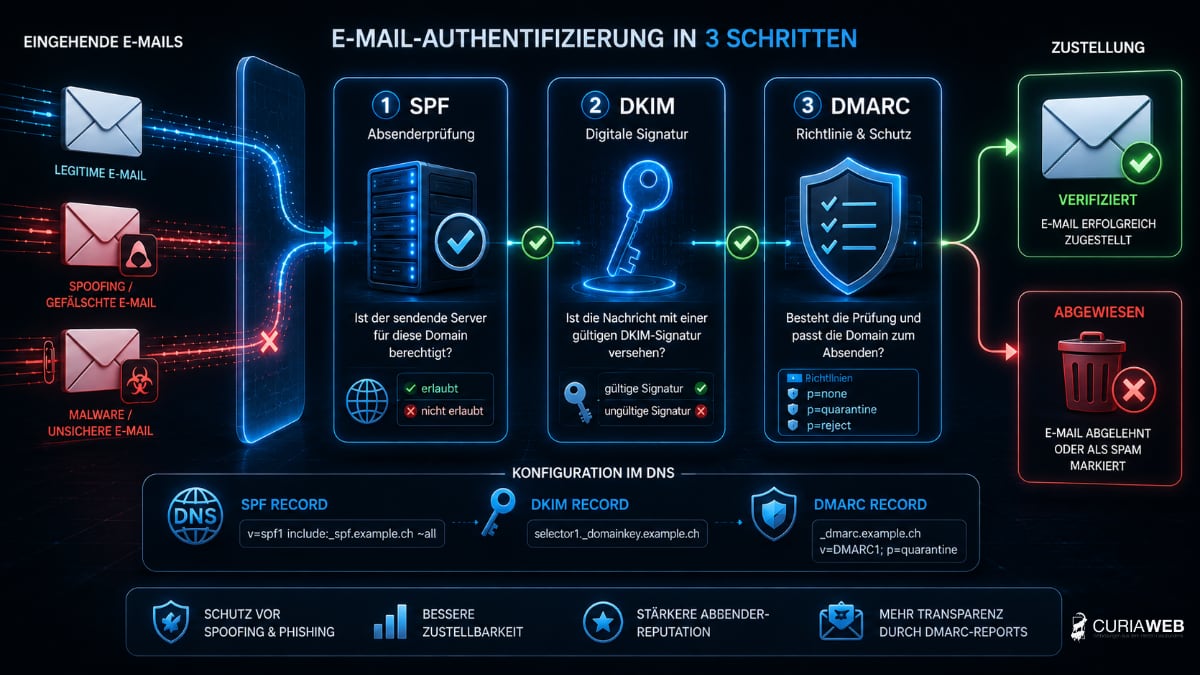
In addition to MX records, SPF, DKIM, and DMARC play a particularly important role in this regard. These methods help authenticate legitimate senders and make it harder to abuse a domain for forged emails.
For more information, please visit our section Email security and spam protection.
Don't forget to renew your domain
A domain must be managed and renewed in accordance with the terms and conditions of the respective registry and registrar. If a renewal is missed, the domain may initially be deactivated depending on the domain extension and the expiration procedure, and may later become available for registration again.
For a company, even a temporary deactivation can have significant consequences:
- the website might no longer be reachable
- business emails can fail
- Customers can no longer reach online services
- in the worst case, the domain can be registered by third parties later
Current contact details, clear responsibilities, and reliable renewal management are therefore important.
Domain Transfer: Change Registrar
An existing domain can be transferred to another registrar. The domain itself and its name remain unchanged.
Reasons for a transfer can include, for example:
- better support
- more transparent prices
- a clearer domain management
- the merging of domain and hosting
A cleanly prepared domain transfer is normally possible without any interruption to the website and email. What is particularly crucial is how nameservers and DNS settings are handled during the transfer.
In our comprehensive guide Domain Transfer Without Downtime: Checklist & Common Mistakes Let's explain the process step by step.
If you want to transfer a domain directly to CURIAWEB, you can find the relevant information on our page for Domain Transfer.
Domain Security: More than just a strong password
A domain is a mission-critical asset. Anyone who gains access to domain management can potentially alter DNS settings, redirect websites, or manipulate email connections.
Clean domain security therefore includes:
- a strong and unique password for the customer account
- Two-factor authentication, if available
- clearly defined access rights
- current contact and recovery data
- regular review of important DNS settings
Access data for registrar, hosting, and other important services should also not be stored unprotected in documents or spreadsheets.
Typical domain errors among SMEs
Many domain problems do not arise from complex technical attacks, but from a lack of responsibilities or historically grown structures.
Typical examples are:
- Nobody knows for sure where the domain is registered.
- the domain is managed via a former agency or employee account
- DNS settings are not documented
- multiple service providers are changing settings independently of each other
- outdated contact information prevents important notifications
- Website, email, DNS, and domain management are unnecessarily complicated and scattered.
Clear responsibilities and a documented infrastructure prevent a large part of these problems.
Consider domain, hosting, and website together
Domain, DNS, website, hosting, and email are technically distinct components, but they work closely together in daily operation.
A clear infrastructure facilitates in particular:
- Error analysis
- Support
- Domain Transfers
- Website migrations
- Email configuration
- Security measures
CURIAWEB combines domain management with Web hosting, email services and personal support from Switzerland.
If an existing website is also to be switched to CURIAWEB, we can also handle the technical migration upon request. You can learn more about this at our free website migration service.
Conclusion: A domain is a central part of your digital infrastructure
A domain is much more than just an internet address. It connects a website, email, and numerous other services, while also serving as an important part of a company's digital identity.
Carefully choosing domains, clearly defining responsibilities, keeping DNS and security in mind, and meticulously preparing transfers creates a stable foundation for long-term operations.
Therefore, especially for companies, it is worth not treating domain management as a minor matter, but rather as an integral part of their own IT infrastructure.