

IT security was long considered a purely technical issue. Firewalls, passwords, updates, and backups were delegated to external service providers or internal IT managers.
The executive management had little contact with this as long as systems were running and no obvious problems arose. This perspective no longer works today.
Digital processes have become the backbone of modern businesses. Email, websites, cloud services, customer data, and online communication form the foundation for sales, customer contact, and numerous internal operations.
The consequences can be correspondingly severe if these systems fail or are compromised. IT security is therefore no longer just a technical issue, but an integral part of corporate management.
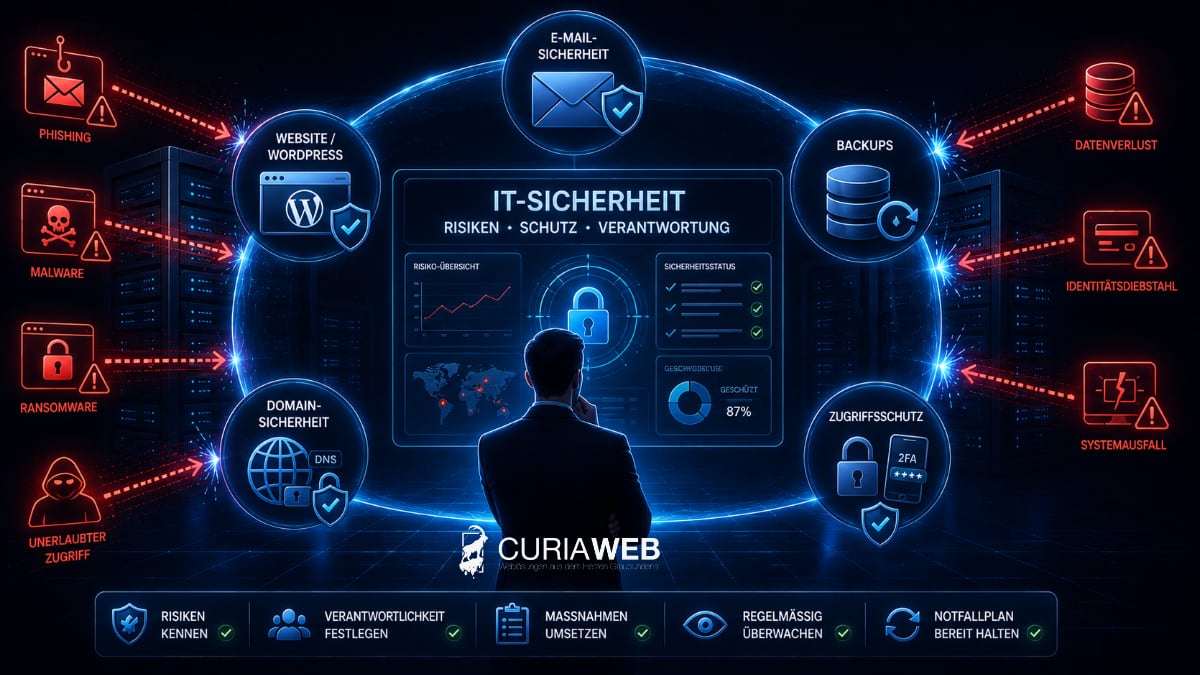
IT security is a business risk
For the executive board, it is not crucial which firewall rule is set or which software version is installed.
The decisive factors are the potential impacts:
- Can the company continue to work during an IT failure?
- What happens when business email goes down?
- How critical would the loss of customer or corporate data be?
- How quickly could systems be restored?
- Who decides and acts in the event of a security incident?
This turns IT security into a classic business risk issue.
The technical implementation can be delegated. However, company management cannot completely delegate the decision of which risk a company accepts.
Why SMEs are attractive to attackers
Cyberattacks have long since not only targeted banks, corporations, or public institutions.
Even small and medium-sized enterprises are attractive targets. They hold usable information, work with payment data and invoices, and possess access to numerous digital services.
At the same time, security structures in SMEs are often less developed than in large companies.
For attackers, a single company doesn't even have to be specifically targeted. Many attacks are automated. Systems are scanned for known vulnerabilities, login credentials are automatically tested, and phishing messages are sent in bulk.
A company can therefore be affected without ever having been deliberately chosen as a target.
Email is one of the most critical attack vectors
Email is for many companies the most important digital communication channel – and at the same time one of the most attractive attack vectors.
For example, attackers can use compromised email accounts to:
- monitoring internal communications
- Perform password resets
- sending fake invoices
- Deceive customers and business partners
- obtain further access credentials
Professionally designed phishing messages are particularly dangerous. They often look like legitimate messages from banks, suppliers, Microsoft, parcel delivery services, or well-known business partners.
Technical protection mechanisms can intercept a large portion of these messages even before they reach the inbox.
You can find more information in the guide SpamExperts: professional protection against spam and phishing .
SPF, DKIM, and DMARC protect your own email domain
Email security isn't just about filtering incoming messages. Companies should also prevent their own domain from being easily misused for spoofed senders.
SPF, DKIM and DMARC play an important role in this. These methods help mail servers verify whether a message actually originates from an authorized system.
This improves both the security and trustworthiness of business email communication.
We explain how the three procedures work together in the article SPF, DKIM, and DMARC explained simply .
Website and WordPress are also part of the security strategy
The corporate website is often viewed as less critical for IT security than internal systems. That is a mistake.
A compromised website can:
- spread malicious code
- Redirect visitors to external sites
- compromise customer data
- damage the company's reputation
- lead to warnings in browsers or search engines
Particularly with WordPress, risks often arise from outdated plugins, themes, or a lack of maintenance.
Regular updates are therefore not part of cosmetic website maintenance, but rather of the security strategy.
Read more: Why WordPress needs regular updates .
Backups are part of IT security
Even good security measures can never completely rule out an incident.
Therefore, a sensible security strategy always includes the question: How do we return to a working state after a problem?
This is precisely where backups become critical.
They not only protect against cyber attacks, but also against:
- accidentally deleted data
- failed updates
- technical defects
- Misconfigurations
It is not enough for „a backup to exist somewhere.“ Backups must be up to date, available, and actually restorable.
We explain which points are important in this guide Backup strategies for SMEs .
People remain a crucial factor
Technical security measures are important, but many successful attacks bypass the technology by manipulating people.
An alleged supplier reports new bank details. A supposed Microsoft notification prompts you to log in again. Or a message from the management requests an urgent payment.
Such social engineering attacks work because they exploit time pressure, trust, or authority.
That is why organizational rules are also part of IT security.
For example:
- confirm unusual payment instructions via a second channel
- Never share passwords via email
- report suspicious messages internally
- use two-factor authentication for important accounts
Security is thus created not only in the server room, but in the daily behavior of the entire company.
Passwords and two-factor authentication
Stolen credentials are one of the easiest ways to infiltrate corporate systems.
That is why important services should not only be protected with strong and individual passwords. Wherever possible, two-factor authentication should also be used.
Even if a password becomes known, an attacker still needs an additional factor as a result.
This is particularly important for:
- Email accounts
- WordPress administrators
- Hosting and domain management
- Cloud services
- Backup systems
Domains are also a security factor
A company's domain is a central part of its digital identity.
Anyone who gains access to domain administration or DNS settings can, in the worst-case scenario, manipulate the website and email traffic.
Domain security should therefore also be part of the corporate security strategy.
This includes, for example, secure access, clear responsibilities, and regular monitoring of important DNS settings.
For more background information, see Domain security for SMEs .
What executive management specifically needs to know
Top priority explicitly does not mean that managing directors have to configure servers or analyze log files.
However, you should be able to get answers to some basic questions:
- Which systems are critical to our business operations?
- Who has administrative access?
- Are important systems updated regularly?
- Are there working backups?
- Is two-factor authentication enabled for important accounts?
- How are business emails protected?
- Who is responsible in the event of a security incident?
- How quickly could critical systems be restored?
If these questions cannot be answered, there is already an organizational need for action—regardless of how modern the technology used is.
A simple emergency plan can be crucial
In a security incident, time counts. Nevertheless, it is often only clarified in an emergency who is actually supposed to do what.
A basic emergency plan does not need to be a hundred-page document for an SME.
He should at least note:
- who is internally responsible
- which IT or hosting partner is contacted
- where important access data are securely available
- which systems need to be restored first
- how employees are informed in the event of an incident
This preparation alone can prevent valuable time from being lost on organizational issues during an incident.
IT security must fit the company
Not every SME requires the same security measures as a bank, a hospital, or an international corporation.
Conversely, „We are too small for cyber attacks“ is not a security strategy.
What is crucial is an appropriate solution based on the actual risk.
For many SMEs, this initially means consistently implementing the basics:
- current systems
- strong credentials and two-factor authentication
- Email protection
- regular backups
- secure domain management
- clear responsibilities
- a simple emergency plan
These measures are neither spectacular nor particularly complicated. Precisely for that reason, they should be a matter of course.
Conclusion: Delegate technology, not responsibility
IT security is a top management priority today because digital risks have directly become business risks.
Management does not need to master server administration or configure security software themselves.
Your task is to understand risks, assign responsibilities, and ensure that appropriate protective measures are in place.
The technical implementation can be delegated to specialists. However, ensuring that IT security is taken seriously within the company remains a management responsibility.